Genre
Currently writing
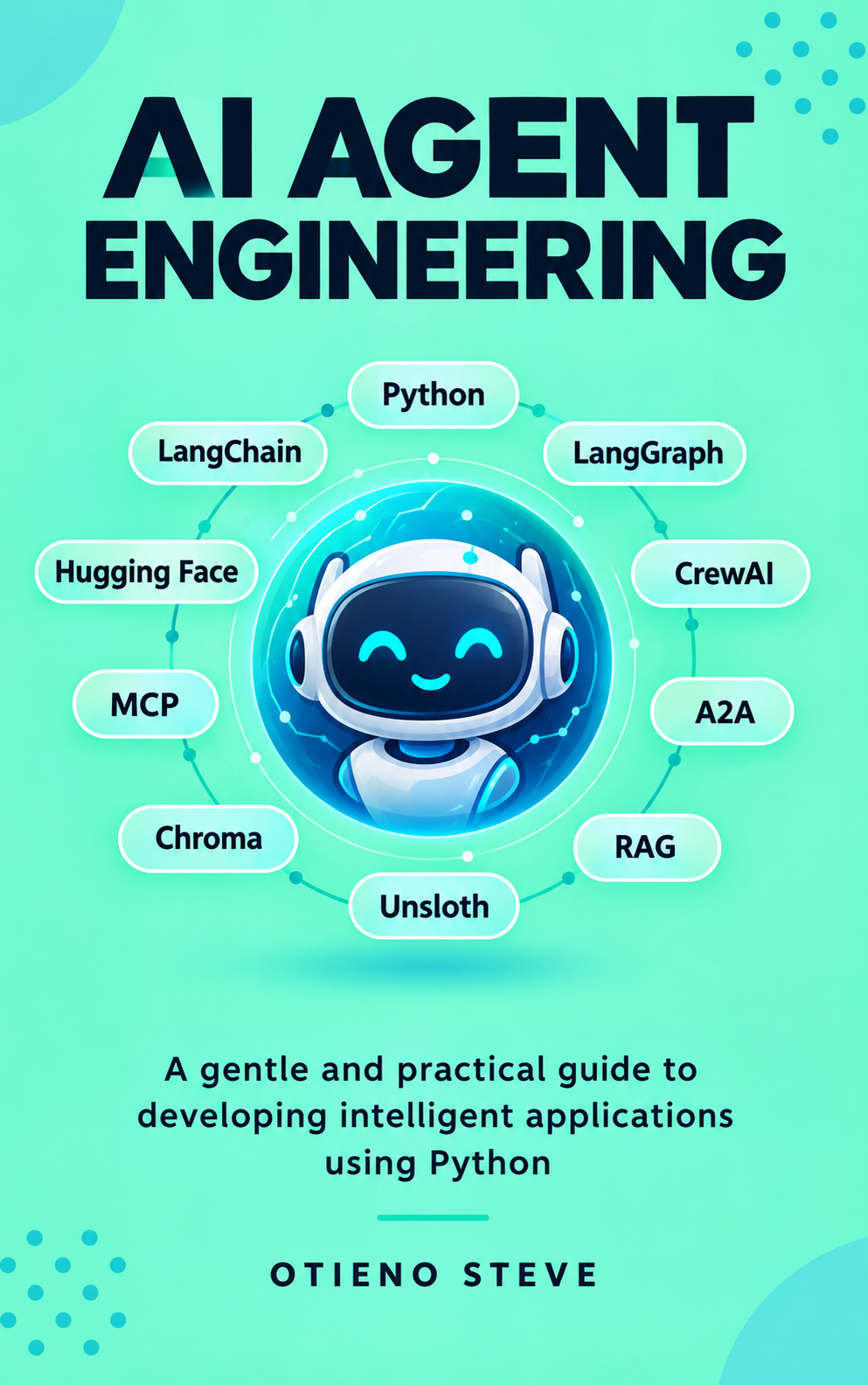
AI Agent
Engineering.
A gentle and practical guide to building intelligent applications
This book is meant for individuals looking forward to advance their skills in AI Engineering, a critical skill for the Artificcial Intelligence age. Just as web design and development was popular during the nascient and subsequent days of the world wide web (www) so is AI Engineering a critical skill for this phase of technological evolution.
Back to the portfolioThe Book
AI Agent Engineering
A gentle and practical guide to developing intelligent applications
Progress
Refactoring Approach, Fact Checking And Review
Expected
February 2027
“Artificial Intelligence is not the first technology to disrupt our world, and it certainly will not be the last. What matters is how well we adapt to it.”The Artificial Intelligence Effect
Inside the book
The Contents.
Timeless, foundational concepts to get good at AI Agent Engineering.
The Artificial Intelligence Effect
This part introduces the artificial intelligence, some of it's fields, the evolution of the technology, its potential, challegnges and limitations.
Agentic AI
This part introduces the concept of Agentic AI. It explores the different types of intelligent workflows, the AI Stack, API primitives, strategies for selecting an AI Model, the model classification techniques and practical examples of interacting with an AI model using the OpenAI API and requests library.
Langchain
This chapter dives into Langchain, one of the most popular libraries for building Agentic AI. Interacting with AI model API's using the Langchain object, The langchain Agent, Middleware and Guardrails, memory...
Prompt Engineering
This chapter explores some of the prompting techniques that can enhance an agents reliability from naive prompting to in-context learning techniques and adnvanced prompting techniques like the interview pattern. The chapter also explores some of the prompts from some popular Agentic AI tools and model providers.
Retreival Augmented Generation
This chapter looks at some of the techniques for building context aware Intelligent applications. It explores Naive RAG in detail, Vector databases, Embedding models and RAG patterns
Tools and Model Context Protocol (MCP)
This chapter explores some of the techniques for integrating intelligent applications with external systems. It begins with the foundations of tool calling then gets into the techniques for using the Model Context Protocol (MCP)
Langgraph
This chapter explores the langgraph framework which is used to build agentic non-linear workflows. This chapter also explores the different agentic design patterns
CrewAI
This chapter introduces the CrewAI framework which is multi-agent, event driven framework for creating intelligent applications.
Agent Interoprability
This chapter delves into the techniques for integrating agents using the (agent2agent) a2a protocol.
Fine Tuning AI Models
This chapter loodelved into more details about AI Models such as the types of development techniques, AI Model types, Neural network architecture, AI Model Fine Tuning, Parameter Enhanced Fine Tuning Techniques and using the unsloth libraray.
Caveats and Emerging Trends
This chapter is reserved for exploring some of the emerging technologies in Agentic AI such as Harness Engineering, Loop Engineering and many more.
A first look
Read a preview.
A taste of the chapters. Tap a chapter to read.
Chapter 1 The Artificial Intelligence Effect
From the invention of the first computing devices such as the Z3 and ENIAC (Electronic Numerical Integrator and Computer) in the 1940s to smartphones and IoT (Internet of Things) devices, technology has evolved significantly over the last 8 decades.
The initial computing devices were bulky, slow and occupied a lot of space, nowadays however, some personal computers such as laptops, tablets and smartphones are portable and significantly much faster than their ancestors.
The irony of the evolution of computing is that we spent years learning the language of computers as it’s usability evolved through various interfaces such as punched cards, the CLI (command line interface), later menu driven interfaces, then the GUI (Graphical user interface), only for the computer through AI, to learn, understand and interact with us through our language.
We mastered tools such as QuickBooks for accounting, the Adobe suite for graphics processing, the Microsoft office suite for document processing, visual studio code for coding tasks, to mention but a few.
Today, AI systems powered by machine learning technologies can assist with many of the tasks, from generating code and analysing financial records to creating graphics and processing documents.
Artificial Intelligence (AI) is a field of computer science concerned with developing systems capable of performing tasks that typically require human intelligence, such as reasoning, learning, problem-solving, perception and language understanding.
While the most popular way of Interacting with AI is through an AI models chat interface such as Claude, Gemini and ChatGPT, intelligence capabilities such as reasoning, text generation ,language understanding and others can be incorporated into any application or process.
For Artificial Intelligence to do more than responding to prompts through conversational chat interfaces, it needs to be integrated into the applications we use every day. This enables AI systems to interact with external systems, retrieve data from various sources, execute tasks and do more than just responding to user prompts. This has been made possible by a specialized field of AI known as Agentic AI, which is the main theme of this book.
AI as a field has existed for over 60 years but the current boom was accelerated by the launch of ChatGPT- an AI chatbot in November of 2022, placing Generative AI - a form of AI that generates novel content, in the hands of everyday users for the first time.
The release of ChatGPT was the watershed moment which ushered in the world to this remarkable technology.
McKinsey describes AI’s progression over the last 3 years as described below.
Nov 2022 - (Launch of ChatGPT)
This was the moment Generative AI (A form of AI that generates novel content) was made accessible to the world for the first time.
2023 - ( Discovering AI )
There was a lot of experimentation to gauge the usefulness of this technology, stemming from the earlier limitations of the technology that didn’t live up to expectations as AI evolved over decades.
2024 - ( Structures, Policies and integration )
After thorough experimentation and testing people discovered the usefulness of the technology and despite some challenges like hallucinations, conversations on how to integrate the technology to processes and functions started alongside determining policies and structures to support the integration.
2025 - (Year of AI Agents)
This year was pivotal as the focus shifted from AI Model chat interfaces to Agentic use cases which brought intelligence closer to and within end user applications.
This was facilitated by earlier and concurrent innovation in agentic orchestration technologies; libraries such as Langchain, LlamaIndex, and Agent Development Kit (ADK), frameworks such as Langgraph and CrewAI, protocols such as Model Context Protocol (MCP) and Agent to Agent protocol (A2A) and techniques such as Retrieval Augmentation Generation (RAG) and Prompt Engineering among others.
These technologies will be discussed in detail in their various chapters.
Our Future Depends on How AI Evolves.
Technological evolution seems complementary; technologies such as personal computing and operating systems paved the way for the internet which ushered in the world wide web and other technologies that sit on top of it including AI.
This modern AI boom, though remarkable, has come with mixed feelings and some level of uncertainty.
For enterprises the value the AI brings is visible; increased efficiency while at the same time the cost of such systems is worrying, and trade-offs have to be made.
For knowledge workers, it has proven to be efficient in supporting the performance of everyday tasks while also threatening the relevance of certain job functions.
In Academia, it has enhanced knowledge acquisition while also challenging current learning methods and accelerating academic dishonesty.
The fact is that all technological advancements have come with some level of uncertainty from the industrial to the digital revolutions and now AI. If history serves us right, just like with the previous disruptive technologies such as personal computing and the world wide web, once the hype has faded, the value of the technology has been captured and proper governance structures are put in place to manage the technology, the uncertainty will subside and we will coexist efficiently with the technology.
Artificial Intelligence is not the first technology to disrupt our world, and it certainly will not be the last. What matters is how well we adapt to it.